The State of Nigerian Real Estate Operations 2026
Joshua Daniel · Marketing Comms
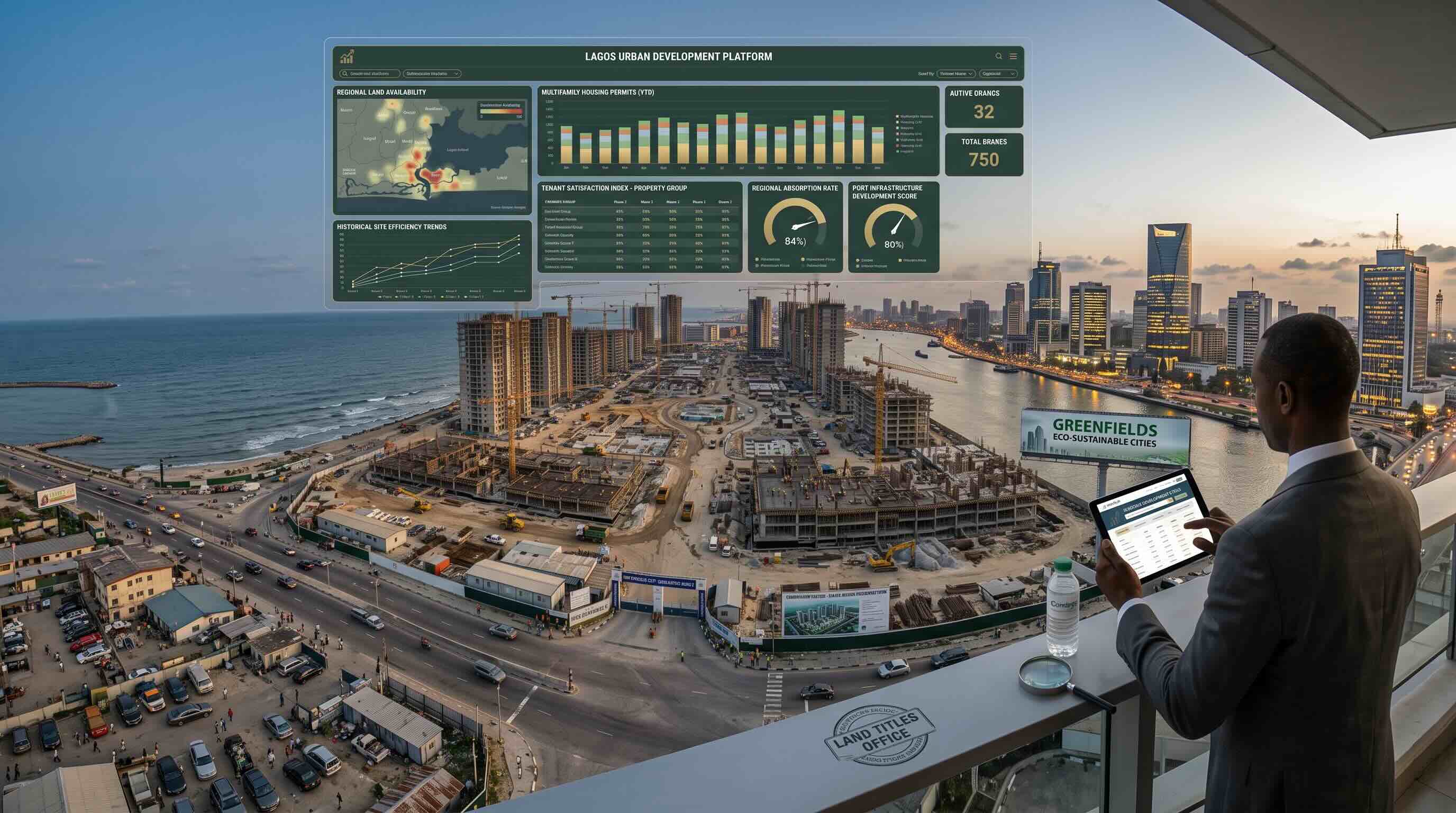
A data-led look at how real estate companies actually run and where the money leaks
Nigeria's real estate sector is enormous, growing, and beneath the headline numbers; running on operational foundations that would alarm most people if they looked closely.
We hear constantly about the size of the market, the housing deficit, and rising prices. What gets far less attention is how the businesses inside this market actually operate day to day; how they sell, how they collect money, how they manage the people who sell for them, and how much simply leaks away through gaps in the process.
This report pulls together what the data does say, and offers an honest read on the operational realities it doesn't fully capture. A note on method up front, because it matters: Nigerian real estate is one of the least formally measured large sectors anywhere. Reliable, sector-wide operational statistics — default rates, no-show rates, reconciliation hours — largely don't exist, precisely because so much of the industry runs informally and keeps no records to measure. Where hard figures exist, they're cited. Where they don't, that absence is itself one of the most important findings in this report, and it's labelled as analysis rather than dressed up as data.
The market: big, growing, and under strain
Start with the scale, because it frames everything else.
Nigeria's real estate market is valued at roughly $2.4–2.6 trillion, with residential assets making up the largest share, and the combined real estate and construction sectors account for close to 18% of national output. This is not a niche — it's a central pillar of the economy.
And demand is structurally locked in. Nigeria's population is approaching 260 million, urban migration continues, and the housing deficit sits somewhere between the Federal Government's newly validated figure of 14.9 million units and industry estimates of over 22 million. Either way, demand massively outstrips supply, and does so year after year.
But scale and growth mask a fragile operating environment. Construction costs have surged — a 50kg bag of cement rose from under $2 in 2019 to around $9, and some material prices have climbed over 300%. Borrowing is expensive, and the market in 2026 is defined by cautious, disciplined buyers who negotiate slowly and scrutinise everything.
For the companies operating in this market, that combination — huge demand, thin margins, careful buyers — makes operational efficiency not a luxury but a survival requirement. Which makes what follows concerning.
Why installment sales define everything
Here is the single most important operational fact about Nigerian real estate, and it explains almost everything else in this report:
An estimated 98% of Nigerian property buyers cannot access mortgages.
In most developed markets, the buyer gets a bank loan, the developer gets paid in full at closing, and the transaction ends. That model barely exists here. With mortgages out of reach for nearly everyone, Nigerian developers have had to become lenders themselves — structuring initial deposits of 30–40% of property value, with the balance spread over 12–36 months, often tied to construction milestones.
Sit with what that means operationally. Every sale isn't a transaction — it's the start of a multi-year financial relationship the company has to manage. A developer with a few hundred customers isn't running a sales business with some admin attached. They're running, in effect, a small unregulated consumer-finance operation — collecting hundreds of recurring payments, tracking who's current and who's behind, managing defaults — usually with none of the systems a finance operation would consider mandatory.
This is the foundation. Now let's look at how the operations built on it actually perform.
Realtors: a huge, uncounted, informal workforce
Ask a simple question — how many realtors are there in Nigeria? — and the data falls apart in your hands.
Directories give wildly different answers depending on what they count: one business database lists just 892 registered real estate agencies, while a major property portal shows over 16,340 agent listings. Neither is close to the real number, because the overwhelming majority of people selling Nigerian property are informal, unregistered realtors — often part-time, working on referral commissions, belonging to no association and holding no licence.
This mirrors the sector as a whole. Roughly 80% of Nigeria's rental market operates informally, and around 80% of the country's workforce is in the informal sector. The realtor community reflects that: a vast, fluid, largely uncounted population of people selling property for commission.
For a company running a realtor network, this creates a specific operational reality. Your sales force may number in the hundreds, but they're not employees — they're independent, they churn, and most of what they do (which prospects they're talking to, what they're promising, who they've introduced) is invisible to you unless you've built a system to see it. The typical company hasn't. It's coordinating this network through WhatsApp groups and personal relationships — which works at ten realtors and quietly breaks at two hundred.
The uncountability isn't just a statistical curiosity. It's a direct symptom of the operational problem: you cannot measure, manage, or optimise a sales force you can't even see.
The sales cycle: long, and getting longer
How long does it take to sell a Nigerian property? Longer than most operators would like, and the trend is the wrong way.
As of 2026, a well-priced residential property in Lagos takes around 150 days to sell, with most listings sitting between 90 and 220 days; land and off-plan units with complex title checks can run 180 to 365 days. Nationally, days-on-market of 120–180 days is realistic. And this is slower than a year or two ago, because high interest rates and cautious buyers have made every transaction more negotiation-heavy.
A long sales cycle multiplies the cost of every operational weakness discussed below. When a deal takes four to eight months to close, there's far more time for a lead to go cold, a follow-up to be forgotten, a prospect to drift, or a competitor to intervene. The longer the cycle, the more the process has to actively hold the deal together — and the less an informal, memory-based process is able to.
Put simply: a slow market punishes weak operations disproportionately. The companies that can keep prospects warm and engaged across a five-month cycle win; the ones relying on a realtor remembering to follow up lose deals in the gaps.
Payment defaults: the silent, unmeasured risk
This is where the installment-sales foundation becomes an operational danger — and where the data gap is most telling.
There is no reliable sector-wide default-rate statistic for Nigerian installment property sales. That absence is itself revealing: you cannot have an industry-wide default figure when most of the industry doesn't track defaults systematically. But the surrounding evidence makes the risk unmistakable.
Off-plan and installment sales in Nigeria are widely acknowledged to carry serious payment-discipline problems on both sides. Developer-side, contracts routinely impose punitive penalties — 5% or 10% of the entire property price for even slight delays in installment payments — and can terminate a contract and retain much of what a buyer has paid if milestones are missed. That developers wrote such aggressive default clauses tells you how real the default problem is.
On the developer's own side, one industry expert noted that most developers experienced significant failure with off-plan schemes in Nigeria, in large part because they leaned on subscriber installments as their primary financing — so when collections faltered, projects stalled.
The operational point is this: in a business where 30–40% comes in as deposit and 60–70% arrives as installments over 1–3 years, the collection of those installments is the business. Yet most operators can't answer the most basic collection question — how much is contractually due to come in today, and how much actually arrived? — without a manual reconciliation exercise. So defaults are discovered late, in aggregate, at month-end or worse, by which point a problem that a phone call could have solved in week one has compounded into a serious loss.
Undetected, silent, compounding default is arguably the single largest operational risk in Nigerian real estate — and it's the one least measured.
Commission management: informal, and a constant source of dispute
Where a large, informal realtor network meets real commission money, disputes are inevitable — and the way most companies manage commissions makes them worse.
In the typical setup, attribution — who introduced this client, who closed the deal, who is owed what — is tracked through screenshots, WhatsApp history, and memory. There is no timestamped record created at the moment a prospect first engages. So when two realtors both claim the same commission (and in a referral-driven network, they frequently do), management has to arbitrate between competing stories with no authoritative record.
The direct cost is the disputed commission. But the indirect cost is larger and rarely counted: every unresolved or unfairly-resolved dispute erodes trust across the entire realtor community. Realtors who don't trust that they'll be credited fairly stop sharing openly, stop collaborating, and hoard leads — which destroys the network effect that makes a realtor community valuable in the first place. Multi-tier commission structures, common in Nigerian networks, compound this further, adding layers of calculation that a spreadsheet handles poorly and a dispute handles worse.
Commission management, done informally, doesn't just cost money. It quietly degrades the productivity of the whole sales force.
Manual reconciliation: the hidden operational tax
No Nigeria-specific study quantifies the hours real estate companies lose to manual reconciliation — but the structure of the work makes the burden easy to see, and it's substantial.
Consider what reconciliation involves for a company with a few hundred installment-paying customers. Someone must cross-reference each customer's payment schedule against actual bank inflows, identify who paid and who didn't, chase discrepancies, update records across multiple spreadsheets that inevitably drift out of sync, and assemble it all into something management can read — typically once a month, because it's too laborious to do more often.
That monthly cadence is the crux of the problem. Reconciliation done monthly means the business operates on a 30-day feedback loop: decisions in one month are made on data from the last. In a sector with thin margins, expensive capital, and silent default risk, a 30-day blind spot is not a minor inefficiency — it's the difference between catching a problem while it's small and discovering it after it's compounded.
The "free" spreadsheet, in other words, isn't free. It's paid for in staff hours, in delayed information, and in the problems that grow unseen between reconciliations.
Lead leakage: the deals that were never lost on merit
Lead leakage — prospects who were genuinely interested but slipped away through gaps in the process rather than genuine rejection — is endemic to informal operations, and the Nigerian context makes it worse.
Again, there's no clean national statistic, but the mechanics are clear. When leads arrive and live in scattered WhatsApp chats with no system tracking them, some are simply never followed up. When a prospect messages outside working hours, the message gets buried. When a realtor is juggling fifteen prospects from memory, some fall through. And across a 150-day-plus sales cycle, there's ample time for a warm lead to cool untended.
The reason this matters so much: leaked leads are, disproportionately, qualified leads. They were interested enough to enquire, to respond, sometimes to agree to an inspection. Losing them isn't like failing to convert a cold contact — it's spilling water carried most of the way up the hill. In a slow, competitive market where acquiring each lead costs real marketing money, letting qualified leads leak out the back of a leaky process is one of the most expensive habits in the industry, and one of the least visible.
Customer follow-up: dependent on memory, and therefore unreliable
Closely related, and worth separating out: the follow-up problem.
The single most qualified prospect in any pipeline is the one who has agreed to the next step — an inspection, a second conversation. Protecting that moment across the days until it happens is where deals are won or lost. Yet in the typical setup, follow-up depends entirely on a busy person remembering to do a small, time-sensitive thing at exactly the right moment — with no automated reminders, no confirmations, nothing holding the appointment together.
The result is a steady stream of no-shows and drift that operators tend to attribute to buyers "not being serious," when the real cause is often just that nothing kept the prospect engaged. In a market where buyers are already cautious and cycles are already long, the absence of reliable, systematic follow-up converts winnable deals into lost ones — quietly, and without anyone quite realising why.
Capacity, not motivation, is the issue. No realtor can reliably hold dozens of time-sensitive follow-ups in their head alongside a full workload. Follow-up is a problem systems solve and memory doesn't.
Documentation: the operational weakness the market is now punishing
Documentation ties the whole picture together, and it's the area where operational weakness has most sharply become a commercial liability.
Nigerian real estate has a well-documented trust problem: fake developers, defective titles, project abandonment, and high-profile enforcement actions — regulators have sealed off estates over undelivered units despite full payment. Buyers know this, and in 2026 they've responded by becoming disciplined, moving toward assets with credible, verifiable documentation and away from anything they can't check.
This is where informal operations get exposed. A company running on chats and spreadsheets cannot quickly demonstrate a clean record — a customer's full payment history, a clear installment schedule, verifiable status. And to a cautious buyer, a seller who can't quickly show a clean record looks indistinguishable from one who doesn't have one. Honesty that can't be demonstrated looks the same as dishonesty.
The government is reinforcing this shift from the top: the move to digital planning approvals (Lagos's Electronic Planning Permit Processing System) creates auditable, verifiable records and squeezes out informal, undocumented practice. The direction is unmistakable — Nigerian real estate is shifting from a trust-me business to a check-the-record business.
Documentation, in other words, has moved from back-office compliance to front-line competitive advantage. The operators who can produce clean records on demand win the disciplined buyer; those who can't, lose to them.
The pattern beneath the numbers
Step back from the individual findings and a single pattern emerges.
Every operational weakness in this report — uncounted realtors, silent defaults, disputed commissions, month-end reconciliation, leaked leads, forgotten follow-ups, undemonstrable documentation — is a variation of the same root problem: Nigerian real estate largely operates without systems that create visibility and records.
The sector runs on informality. And informality, which felt natural and even friendly when businesses were small, becomes a serious liability at scale, in a market that is now large, cautious, thin-margined, and increasingly demanding of proof. The 80% informality figure that describes the rental market and the workforce describes the operations too.
The good news hidden in this is that the problems are structural, not personal. Operators aren't losing money because they're careless or lazy — many work extremely hard. They're losing it because they're running multi-year, multi-hundred-customer financial operations on tools designed for far simpler businesses. That's a fixable problem. It's a question of infrastructure, not effort.
What 2026 asks of Nigerian real estate operators
The market conditions of 2026 — expensive capital, disciplined buyers, thin margins, tightening regulation, a shift toward verifiable records — all point the same way. They reward the operators who can see their business in real time and prove it to buyers, and they punish those who can't.
Concretely, that means being able to answer, on any given day:
How much installment revenue is due today, and how much actually came in?
Which customers are falling behind — early, while it's still fixable?
Which realtors are producing, and who is owed exactly what?
Where does every lead and prospect stand, and what's the next action?
Can I show a buyer a clean, complete record of their transaction, instantly?
Most Nigerian real estate companies cannot answer these today. The ones that build the ability to — that trade informality for visibility and records — are the ones positioned to win the disciplined buyer, avoid the silent losses, and scale past the point where informality breaks.
The sector is being formalised, from the buyer's expectations up and the government's regulations down. The operators who formalise their own operations to match won't just comply with that shift. They'll be the ones who profit from it.
This report draws on published figures from the Centre for Affordable Housing Finance Africa, Statista, Nigeria Property Centre, the Federal Government's National Housing Data Technical Committee, Ubosi Eleh + Co's Nigeria Real Estate Report 2026, and industry reporting from Guardian Nigeria, BusinessDay, and others. Operational realities not captured in formal statistics are presented as analysis, grounded in the structural facts of the market. Where a figure could not be reliably sourced, none is invented — the absence of operational data is itself a central finding of this report.
Conveya gives Nigerian real estate companies the operational visibility this report describes — live installment collections, realtor management, commission attribution, and records you can show on demand. Built for how the business actually works here.